Inaugural lecture of Stephan Kemp: “Boundless (Grenzeloos)”
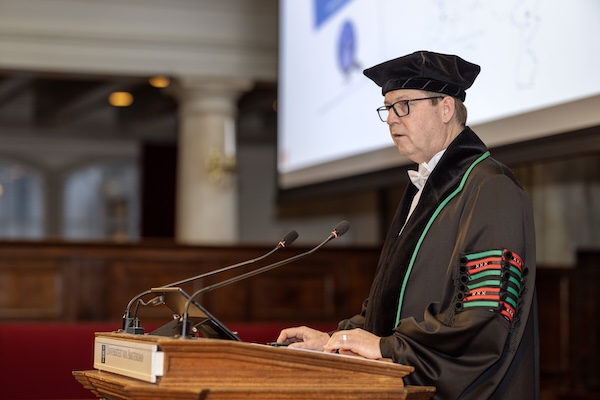
On January 29, 2025, Professor Stephan Kemp delivered his inaugural lecture at the “Oude Lutherse Kerk”, following his appointment as full professor of Inherited Neurometabolic Disorders and Newborn Screening at the Faculty of Medicine of the University of Amsterdam. [Click to read more ▼]
We often expect clear, yes-or-no answers from medical tests, such as genetic screening or blood tests. However, the reality is more complex. In recent years, it has become clear that population screening, including newborn screening, is identifying genetic variants that were not previously identified. These variants were either not associated with disease or because they are associated with mild symptoms at the extreme end of a clinical spectrum, so they went unnoticed. Biochemical tests can also produce results that fall into a “grey zone”: higher than normal, yet not high enough to confirm a diagnosis. Identifying a genetic variant of uncertain significance (VUS) or a value in the grey zone is challenging due to the resulting diagnostic uncertainty and confusion.
Stephan spoke about the delicate balance in newborn screening. Lower cutoffs increase sensitivity but also yield more false positives, while higher cutoffs may miss true cases. He shared his research journey on ALD, including the successful nomination of ALD for inclusion in the Dutch newborn screening program, the challenge of developing an algorithm to screen only boys for ALD, the experience of families, the start of ALD newborn screening in the Netherlands on October 1, 2023, and the worldwide “Grey Zone Project”, an innovative framework that helps families with a VUS following an inconclusive newborn screening result.
The inaugural lecture can be viewed at: Grenzeloos